
Service / Statewide NC
Forestry Mulching That Opens Up Overgrown Ground in One Pass
Forestry mulching cuts and grinds standing brush and small trees right where they stand, leaving a layer of mulch on the ground. It is one of the fastest ways to reclaim overgrown acreage without bare dirt, burn piles or truckloads of debris.
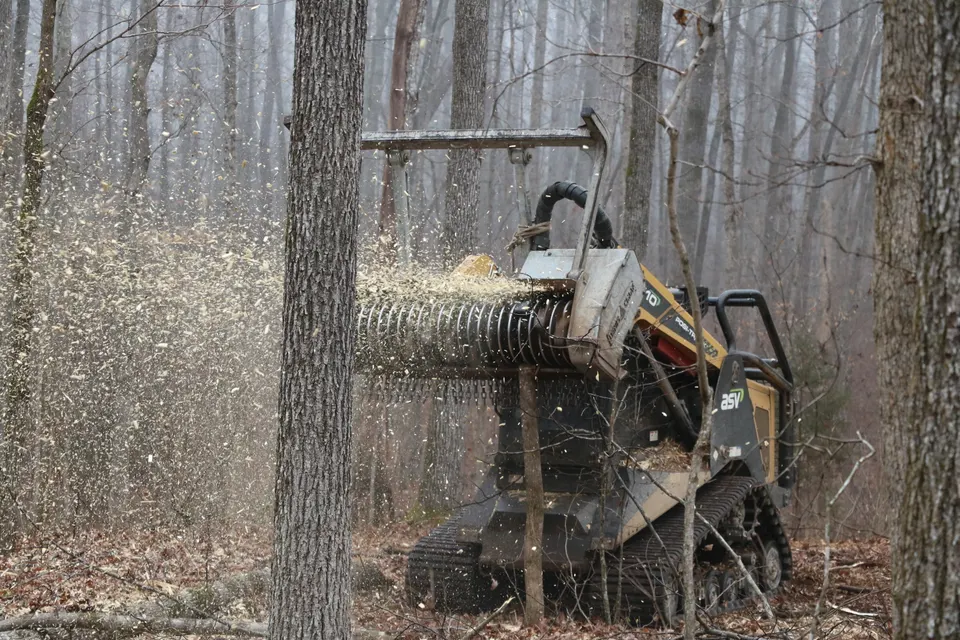
How forestry mulching works
A forestry mulcher is a heavy rotating drum lined with carbide or steel teeth, mounted on a tracked machine. The operator lowers it onto brush, saplings and small trees, and the head chews the material down into chips that drop back onto the ground. Trees are taken down and processed in the same motion, so there is no separate felling, dragging or piling step.
What you are left with is a layer of shredded wood over the soil, with the root systems still in the ground. That mulch layer shades out a lot of new growth, slows erosion on slopes, and breaks down over time. For many North Carolina properties that are overgrown but not headed for a foundation, it is the most practical way to get the land back.
Where mulching fits and where it does not
Mulching shines on overgrown pasture, wooded lots you want to walk and enjoy, hunting land, trail and fence line work, view corridors, and understory thinning under taller trees you want to keep. It is also a good fit when you do not want a muddy, rutted site afterward, because the mulch cushions the ground under the tracks.
It is not a substitute for full clearing when you are building. Stumps are ground to around grade, not pulled, and the mulch layer itself is organic material that should not sit under a slab, footing or driveway base. If a portion of the property is going to be built on, the usual approach is to mulch the broader area and fully clear just the building footprint.
Typical machinery
Most forestry mulching is done with a dedicated tracked carrier running a drum mulcher, or a high-flow compact track loader with a mulching attachment. Larger carriers handle bigger diameter material and open ground quickly, while compact machines fit through gates and work closer to houses, outbuildings and property lines. Teeth style matters as well: carbide teeth hold up in rocky ground, while knife-style teeth cut cleaner in softer material.
Edges, around keeper trees and close to structures, are often finished with saws and handheld trimmers so the machine is not forced into a spot where it could do damage.
Factors that shape the quote
Density is the big one. Light, waist-high brush can be covered quickly, while thick stands of cedar, privet, sweetgum saplings and briars take many more passes. Diameter matters too, since a mulcher can process good-sized trees but each one takes time. Acreage sets the scale, though a dense half acre can take as long as an open two acres.
Slope affects how the machine can travel and how fast it can work safely. Access affects what size carrier can get in. Hidden obstacles such as old fencing, buried wire, rock, and trash piles slow work down and can damage teeth, so let us know if you suspect any. Because mulching leaves everything on site, there is no haul-off charge to think about, which is one reason owners choose it over conventional clearing.
What the ground looks like afterward
Right after mulching, expect a brown, textured carpet of chips with stumps ground roughly level. Within a season, grass and low plants usually work back in through the mulch in open sun. Some hardwoods will sprout from roots, so a follow-up mowing or a second light pass may be worth planning if you want the area to stay open.
FAQ
Straight answers
Will forestry mulching kill the stumps?
It grinds stumps to around ground level but does not remove roots. Pines generally do not resprout. Many hardwoods will push new shoots, which regular mowing usually handles.
How big a tree can a mulcher take?
It depends on the machine and head. Larger carriers process sizable trees; compact setups are better suited to brush and smaller saplings. Very large trees are usually felled and handled separately.
Can I build right after mulching?
Not directly on the mulched area. The mulch and ground stumps should be removed from any footing, slab or driveway footprint. Mulching the rest of the property and fully clearing the building pad is a common combination.
Is mulching good for steep ground?
Often, yes. Leaving a mulch layer instead of bare soil helps hold slopes. Very steep grades still limit what any machine can safely do, so we look at slope closely before quoting.
Do you need to see the property first?
Photos from several angles and a rough boundary are usually enough to start. Video walking the edge of the brush is even better.
Ready when you are
Send the ground. Get a straight answer.
A few phone photos of the property and a rough idea of what you want it to become is enough to start. We will tell you what it takes, what it will not take, and whether we are the right crew for it.